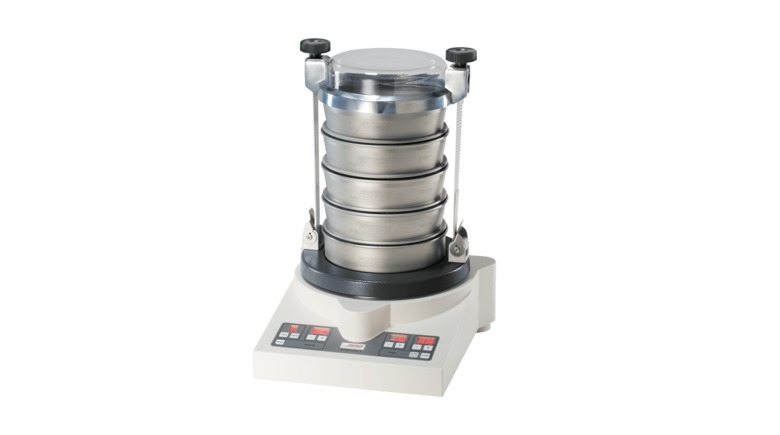
Analysette 3 Pro

Precise sieving with automatic amplitude control.

The high performance Vibratory Sieve Shaker ANALYSETTE 3 PRO offers everything you need for fast determination of quantitative particle size distribution in the laboratory. As a shaking sieve system with an electromagnetic drive oscillates the sieve stack into regulated vertical oscillations, and is the ideal solution for sieving sample quantities up to 2 kg and a measurement range from 20 μm to 63 mm.

The ANALYSETTE 3 PRO is perfectly suited for fast quality control of incoming and outgoing products, offers user-friendly operation and is low-noise, robust and long-lasting. Perfect for quantitative particle size analysis of solids and suspensions of all kinds through dry or wet sieving with woven test sieves.

Our top model with automatic amplitude control, programme selection and the ability to be used as a calibratable and validatable test instrument in test equipment monitoring according to ISO 9001 and much more.


Productfinder – Dry and Wet Sieving

Got Curious?

Read more news articles and stay up to date on the latest news and events in the world of materials characterization, sample preparation and laboratory automation. From product launches to upcoming webinars, we've got you covered. Don't miss the latest developments - check back often to stay up to date!

Equipment Outlet – search & find

We are clearing out and selling demo devices at low prices, among other things. Maybe there is something for you…

User Meeting on “Laser Particle Measurements”

Are laser particle measurements part of your daily lab routine? In our user seminar “Laser Particle Measurements,” we’ll show you practical ways to get the most out of the Particle Sizer and discuss application topics directly with experts.

Tracomme Food Science Day – From Structure to Stability

Exclusive insights into modern analytics, process technology and material characterisation for the food industry. How are food’s properties formed? What role do fat, water, proteins and particle structures play – and how can we specifically understand, influence and optimise them?