Home » Competencies » Material Characterisation » Volume Determination

Volume Determination

In addition to the fast three-dimensional digitization of products, we offer the possibility to measure objects that are not possible to be measured with the seed shift due to their nature or size.

Traditionally, volume measurements of baked products have been obtained by the technique of seed displacement, in which the amount of rape seed or pearl barley packing around the loaf in a standard container is measured. Whilst this method has been universally recognised for decades as indicative of baking quality, it is now considered primitive, inaccurate, tedious and laborious. Repeated calibration, operator dependence, loss of rapeseed due to spillage/adherence of seeds to the product or to static electricity, seed clumping due to moisture absorption, periodic sieving of the seed to remove food crumbs, the potential crushing of soft products and the manual recording of results are the common drawbacks affecting both the efficiency and the accuracy of the measurement.


Laser Volume Scanner

Latest News & Events

Stay up to date on the latest news and events in the world of materials characterization, sample preparation, and laboratory automation. From product launches to upcoming webinars, we've got you covered. Don't miss the latest developments - check back often to stay up to date!

Equipment Outlet – search & find

We are clearing out and selling demo devices at low prices, among other things. Maybe there is something for you…

User Meeting on “Laser Particle Measurements”

Are laser particle measurements part of your daily lab routine? In our user seminar “Laser Particle Measurements,” we’ll show you practical ways to get the most out of the Particle Sizer and discuss application topics directly with experts.

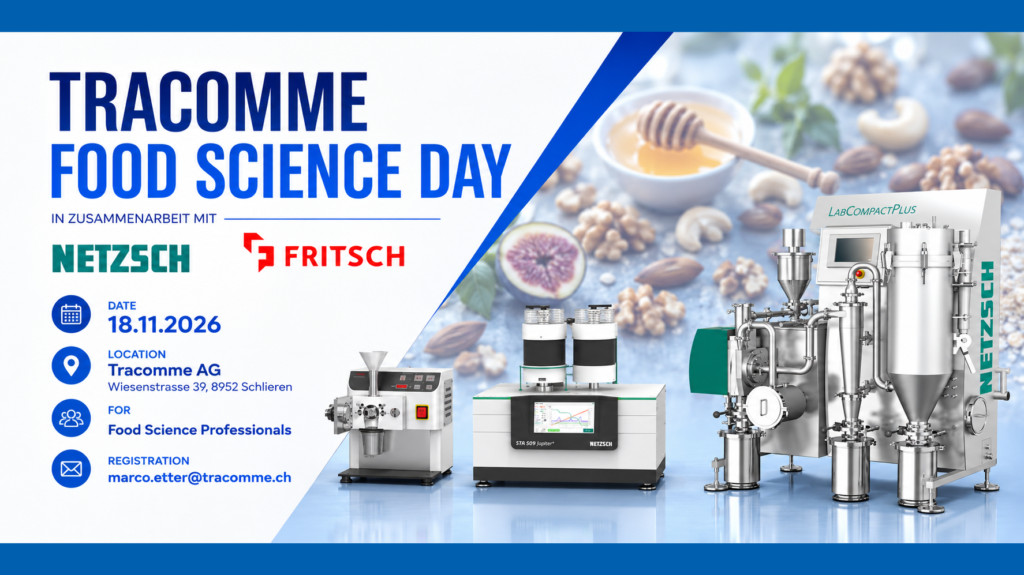
Tracomme Food Science Day – From Structure to Stability

Exclusive insights into modern analytics, process technology and material characterisation for the food industry. How are food’s properties formed? What role do fat, water, proteins and particle structures play – and how can we specifically understand, influence and optimise them?