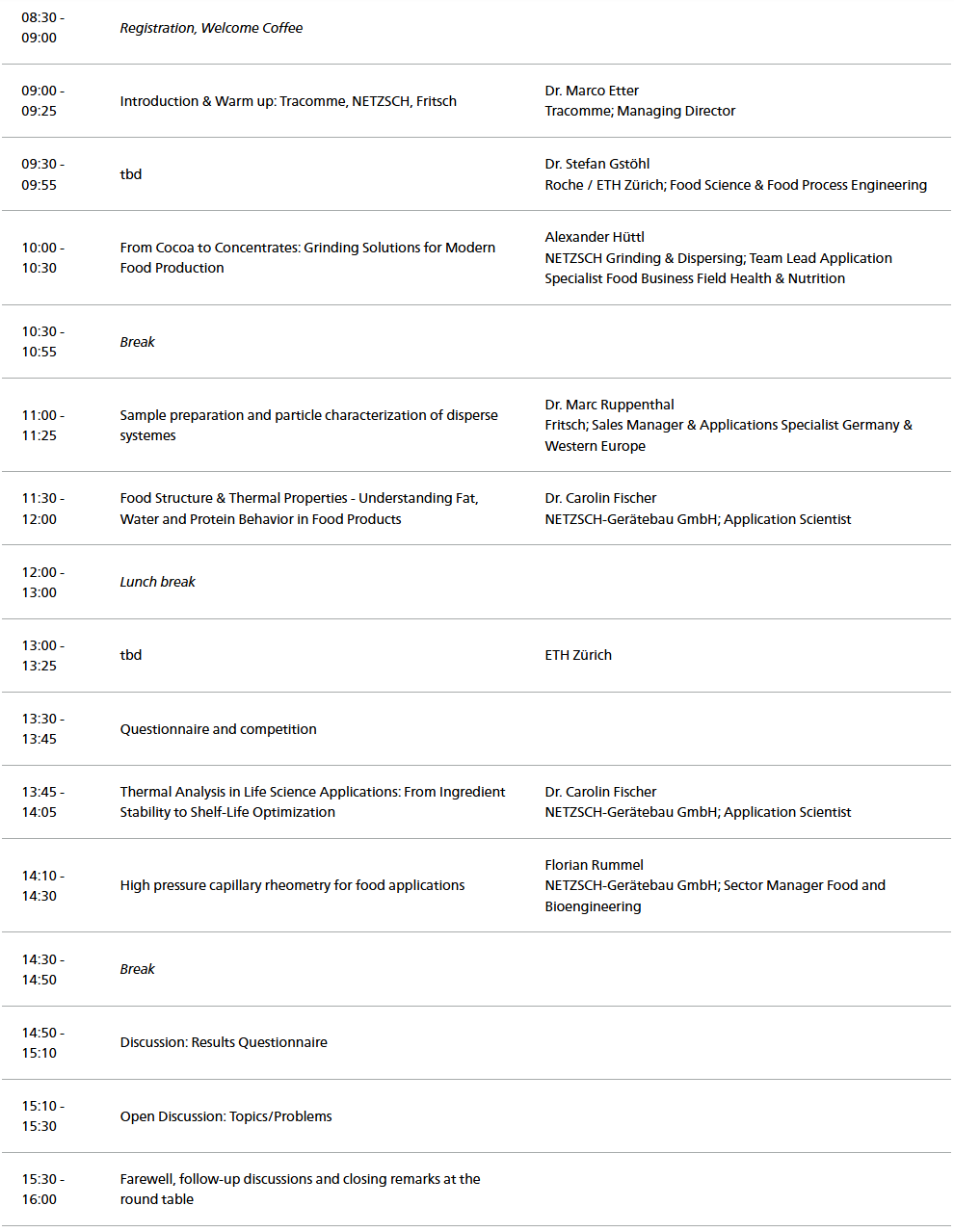
At our exclusive Food Science Seminar, we demonstrate how modern technologies can be applied throughout the entire process chain – from sample preparation and grinding, through dispersion and particle technology, to thermal analysis and the characterisation of materials. Together with recognised experts from research and industry, we explore the interrelationships between structure, processing, product quality and stability. This is not just about individual measurement methods or machines. We will demonstrate how state-of-the-art technologies can be combined to address specific challenges in food development and production – in a practical manner and using selected food applications.
From raw material and particle structure, through thermal and physical behaviour, to product stability and shelf life, this approach provides a holistic view of food.
Date: Thursday, 18 November 2026, 8.30 am – 4.30 pm
Venue: Tracomme AG, Wiesenstrasse 39, 8952 Schlieren
Please register by Friday, 6 November 2026 at Tracomme Food Science Day – NETZSCH Analyzing & Testing.
The number of participants is limited. Places will be allocated on a first-come, first-served basis.


Program