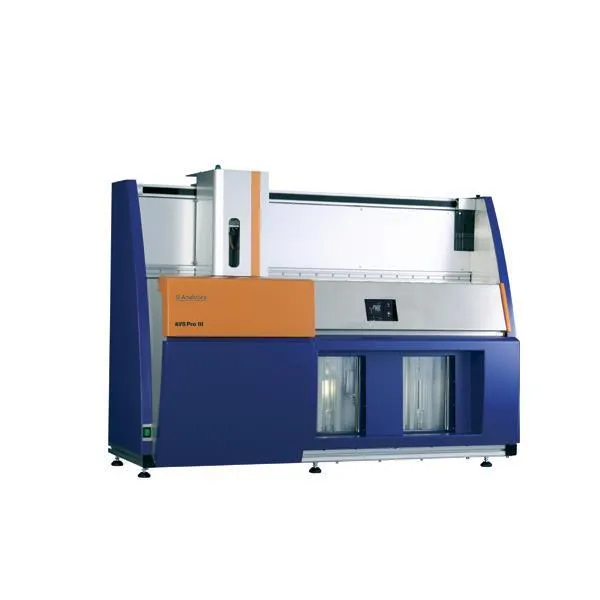
AVS Pro III

The automatic sampler AVS® Pro III is a PC-controlled, fully automatic measuring station for determining viscosity, viscosity number, intrinsic viscosity, etc.
Despite its high sample throughput, the AVS® Pro III is characterized by the highest level of accuracy and reproducibility off. Working with the automatic sampler is easy and allows unsupervised day and night operation.

The AVS® Pro III, now in its 3rd generation with many improvements, has proven itself particularly in the quality control of polymers. Worldwide, most manufacturers of polyamide, polyester, etc. rely on the AVS® Pro III for high sample throughput and safety requirements. And many polymer processors are increasingly using the AVS® Pro III in their QC.

Depending on the application and customer requirements, the device can be supplied in a wide variety of configurations:

  • Usually 2 to 4 measuring stations
  • Macro or micro dosing module depending on the type of viscometer used
  • Rinsing either with the next sample or with rinsing solvent and subsequent drying
  • Different waste systems

Got Curious?

Read more news articles and stay up to date on the latest news and events in the world of materials characterization, sample preparation and laboratory automation. From product launches to upcoming webinars, we've got you covered. Don't miss the latest developments - check back often to stay up to date!

Equipment Outlet – search & find

We are clearing out and selling demo devices at low prices, among other things. Maybe there is something for you…

User Meeting on “Laser Particle Measurements”

Are laser particle measurements part of your daily lab routine? In our user seminar “Laser Particle Measurements,” we’ll show you practical ways to get the most out of the Particle Sizer and discuss application topics directly with experts.

Tracomme Food Science Day – From Structure to Stability

Exclusive insights into modern analytics, process technology and material characterisation for the food industry. How are food’s properties formed? What role do fat, water, proteins and particle structures play – and how can we specifically understand, influence and optimise them?